
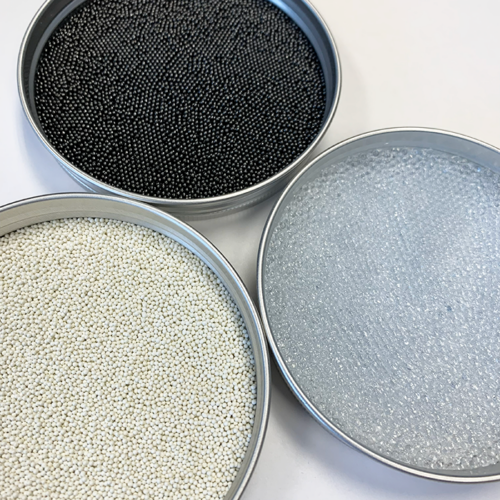
Grinding Media for Wet Media Milling Applications
Grinding media selection plays a critical role in particle size reduction, dispersion, and overall product quality. While media mill design and operating parameters control how energy is generated, grinding media determines how effectively that energy is transferred to the product. Media material, size, and density influence milling intensity, processing time, and wear on both the media and milling equipment.
Customers use EMI Mills grinding media across laboratory, pilot, and production-scale operations, selecting media based on process requirements rather than a one-size-fits-all approach.
Grinding Media Types from EMI
EMI Mills offers a focused range of grinding media materials for wet media milling applications. Each media type offers distinct performance characteristics related to density, wear resistance, and milling efficiency. The table below summarizes the key differences at a glance.
| Media Type | Relative Density | Milling Energy Transfer | Wear Resistance | Typical Use Profile | Cost Position |
|---|---|---|---|---|---|
| Yttrium Stabilized Zirconia (YTZ) | Very High (6.0 g/cm³) | Very High | Excellent | High-energy milling, fine particle-size reduction and higher-viscosity formulations | High |
| Zirmil® YP Pharmaceutical YTZ | Very High (6.0 g/cm³) | Very High | Excellent - Purity Focused | Pharmaceutical, biotechnology and contamination-sensitive applications requiring high purity and controlled bead sizing | Highest |
| Cerium Stabilized Zirconia | Very High (6.2 g/cm³) | Very High | Very High | Extended production runs where media life, stable milling behavior and operating cost efficiency are priorities | High |
| Zirconium Silicate | Moderate (3.8 g/cm³) | Moderate | Moderate | General-purpose milling and dispersion where a balance of performance and cost is required | Mid-range |
| Glass | Low | Low | Low to Moderate | Light-duty milling and dispersion where economical operation is the priority | Lowest |
Relative performance characteristics shown for comparison. Actual performance depends on bead size, formulation, mill configuration and operating conditions. Detailed specifications are provided on individual media pages.
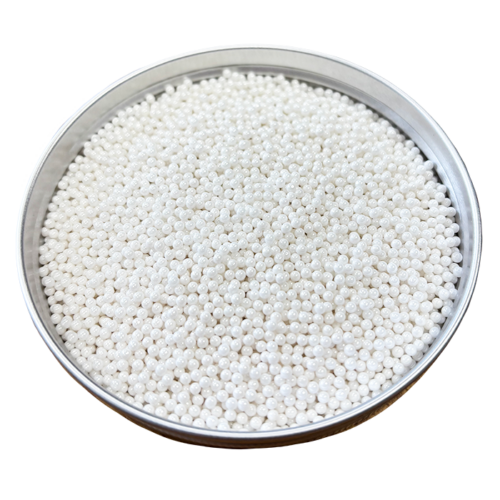
Yttrium Stabilized Zirconia (YTZ)
Yttrium stabilized zirconia (YTZ) grinding media is a high-density ceramic media commonly used in demanding milling applications requiring efficient energy transfer and fine particle-size reduction. EMI supplies standard Zirmil® Y, Fine Zirmil® Y and Ultrafine Zirmil® Y products across bead sizes from 0.03 mm to 5.0 mm.
Manufacturers select standard YTZ grinding media when consistent performance, extended media life and reduced wear are priorities in high-viscosity or high-energy wet milling operations.
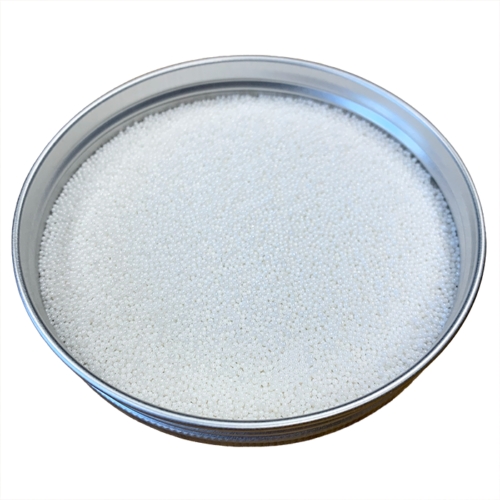
Zirmil® YP Pharmaceutical YTZ
Zirmil® YP is a high-density, high-purity yttria-stabilized zirconia grinding media designed for pharmaceutical, biotechnology and other contamination-sensitive wet milling applications. Its high hardness, wear resistance and controlled bead-size distribution help minimize product contamination while supporting consistent nanomilling performance.
Available in nominal sizes from 0.1 mm to 1.0 mm, Zirmil® YP is commonly used for nanomilling active pharmaceutical ingredients, pharmaceutical suspensions and cell disruption.
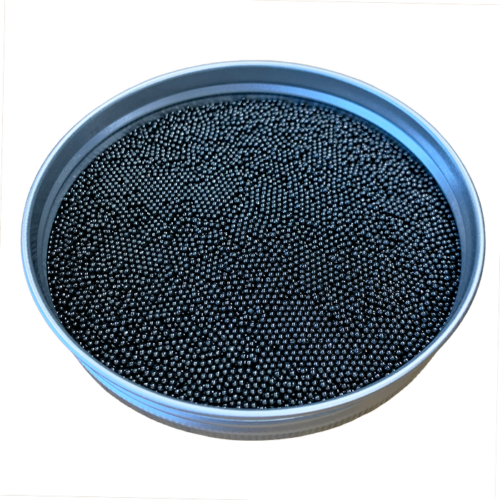
Cerium Stabilized Zirconia
Cerium stabilized zirconia grinding media is a premium ceramic option engineered for toughness and long service life under continuous milling conditions. This media type offers excellent wear resistance and stability, making it suitable for extended production runs where consistent milling behavior is required.
Cerium stabilized zirconia media is used in applications where minimizing media wear and maintaining consistent particle size distribution are important considerations.
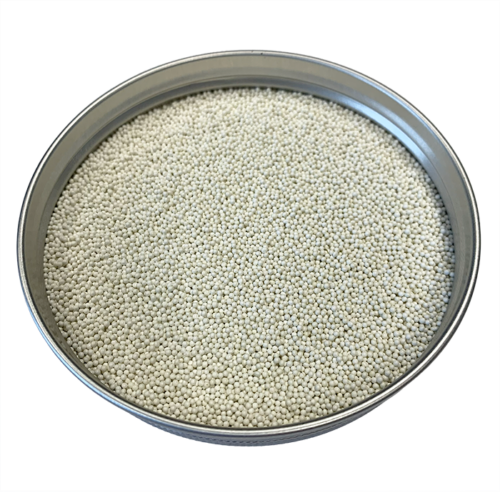
Zirconium Silicate
Zirconium silicate grinding media is a versatile, general-purpose option used across a wide range of wet media milling applications. With a moderate density relative to zirconia-based media, it provides a balance between milling efficiency and cost.
Manufacturers select this media type for general dispersion processes where extreme density or wear resistance is not required.
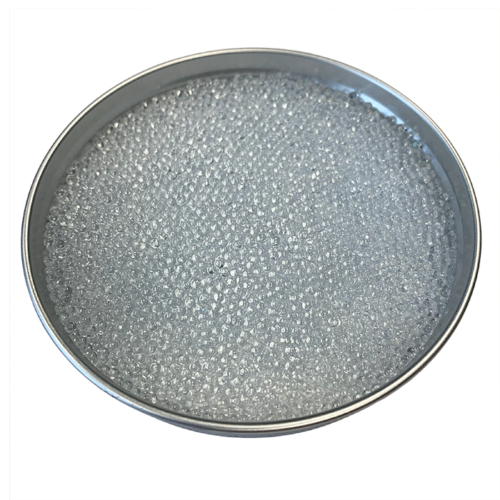
Glass
Glass grinding media is a cost-effective option for lighter-duty wet milling and dispersion applications. Its lower density makes it suitable for lower-viscosity systems and processes where aggressive milling energy is not required.
Glass media is used in applications where economical operation and reduced contamination risk are primary considerations.
Grinding Media Selection Considerations
Process behavior in the mill drives grinding media selection, not theory alone. The considerations below reflect the questions most commonly reviewed when confirming grinding media material and size for wet media milling applications.
Media Size: Impact vs. Contact
Grinding media size affects how energy is applied to the product, but there is rarely a single “correct” size. Selection is based on the balance between impact energy and surface contact.
When does it make sense to use smaller grinding media?
- When finer particle size reduction is required
- When increased surface contact improves dispersion
- When the product flows easily within the mill
When does it make sense to use larger grinding media?
- When higher impact energy is needed
- When faster size reduction or higher throughput is the priority
- When product viscosity limits effective movement of smaller beads
In practice, media size is adjusted incrementally rather than changed completely.
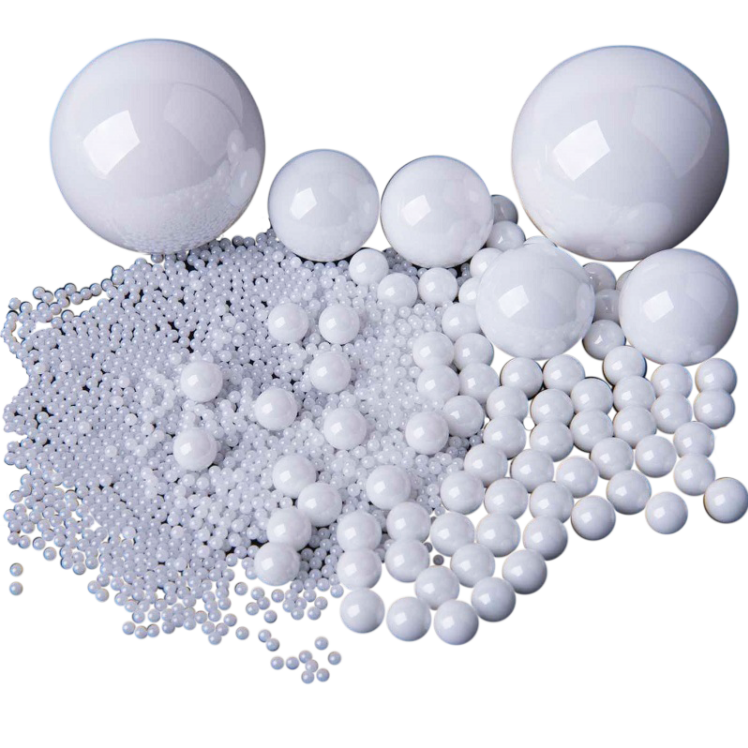
Media Density = Intensity
Media density controls how much energy is transferred during each collision. Higher density increases milling intensity, but also increases mechanical load within the system.
When does higher-density grinding media make sense?
- When aggressive milling is required
- When processing time needs to be reduced
- When the formulation can tolerate higher energy input
When does lower-density grinding media make sense?
- When milling intensity needs to be moderated
- When wear on mill components is a concern
- When the process does not require maximum energy transfer
Density selection is a tradeoff between efficiency and wear rather than a performance maximum.
Product Viscosity and Flow Behavior
Product viscosity directly affects how grinding media circulates within the mill. Changes in formulation trigger changes in media behavior.
When viscosity is lower:
- Smaller media sizes are viable
- Media movement is less restricted
- Energy distribution is more uniform
When viscosity increases:
- Media circulation becomes limited
- Larger or denser media is required
- Milling efficiency drops if media selection is not adjusted
This is a common reason grinding media selection is revisited.

Wear and Contamination Considerations
Grinding media material influences both wear behavior and contamination risk. Selection is often based on what the process can tolerate rather than what delivers maximum milling energy.
When wear resistance is a priority:
- Ceramic media is often selected
- Extended media life may reduce downtime
- Consistency across long production runs is easier to maintain
When contamination sensitivity is a concern:
- Media material compatibility becomes critical
- Wear characteristics are evaluated carefully
- Media selection may prioritize purity over milling intensity
Packaging and Availability
Grinding media is available in multiple size ranges and packaging options to support laboratory, pilot and production-scale milling operations. Packaging varies by media type, bead size and order quantity. Generally, quantities from 1 kg through 10 kg and standard 20 kg plastic containers are available.
Zirmil® YP pharmaceutical grinding media is offered in 1 kg, 5 kg, 10 kg and 20 kg plastic containers. Most customers order grinding media in consistent configurations once a process is established, but additional sizes or packaging formats may be available upon request.
Availability is confirmed at the time of inquiry based on media type, bead size and order volume.
Compatible Equipment
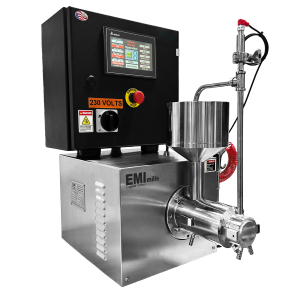
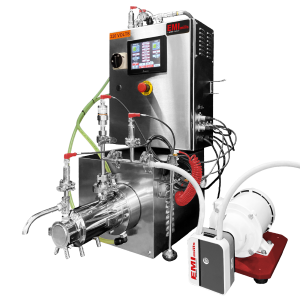
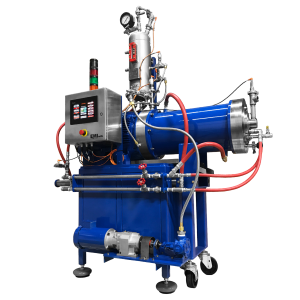
EMI grinding media can be used across EMI laboratory, pilot and production wet media mills. Compatibility depends on the selected media material, bead size, mill configuration and media-separation system. Select a mill below to view equipment details, or contact EMI for help matching the media to your process
Grinding Media FAQs
What is the benefit of using higher-density grinding media?
Higher-density grinding media transfers more energy during milling, which improves milling efficiency and supports finer particle size reduction in certain applications. Increased density reduces processing time, but increases wear on both the media and mill components depending on operating conditions.
Can different grinding media be mixed in the same mill?
In some cases, different grinding media sizes or materials may be used together, but this is evaluated on a process-specific basis. Mixing media affects milling behavior, wear patterns, and consistency, so it must be reviewed carefully before implementation.
How do I know when to replace my grinding media?
Grinding media is replaced when excessive wear is observed, milling performance declines, or particle size targets become difficult to maintain. Visual inspection, changes in process efficiency, and historical run data are used to determine when replacement is required.
Does grinding media affect contamination levels?
Yes. Grinding media material and wear characteristics influence contamination levels in the milled product. Media selection is guided by compatibility with the formulation, sensitivity to contamination, and acceptable wear behavior for the application.
What maintenance is required for grinding media?
Grinding media maintenance primarily involves routine inspection for wear, breakage, or contamination buildup. Proper cleaning and timely replacement maintains consistent milling performance and protects mill components.
Can the same grinding media be used across different EMI mills?
Many grinding media products can be used across EMI Mini Mills, Pilot Mills and Production Mills, along with Schold’s Horizontal Media Mill. Compatibility depends on the bead size, mill configuration, media-separation system and operating parameters rather than mill size alone.
What grinding media is recommended for pharmaceutical applications?
Zirmil® YP is specifically designed for pharmaceutical, biotechnology and other contamination-sensitive wet milling applications. Its high-purity yttria-stabilized zirconia composition, wear resistance and controlled bead-size distribution make it suitable for nanomilling active pharmaceutical ingredients, pharmaceutical suspensions and cell disruption. Final selection should account for the formulation, target particle size and mill configuration.
Where can I get assistance with grinding media selection?
EMI provides technical support to assist with grinding media selection, availability, and compatibility with specific milling processes. Contact EMI Mills to discuss media material, size ranges, and packaging options based on your application requirements.